
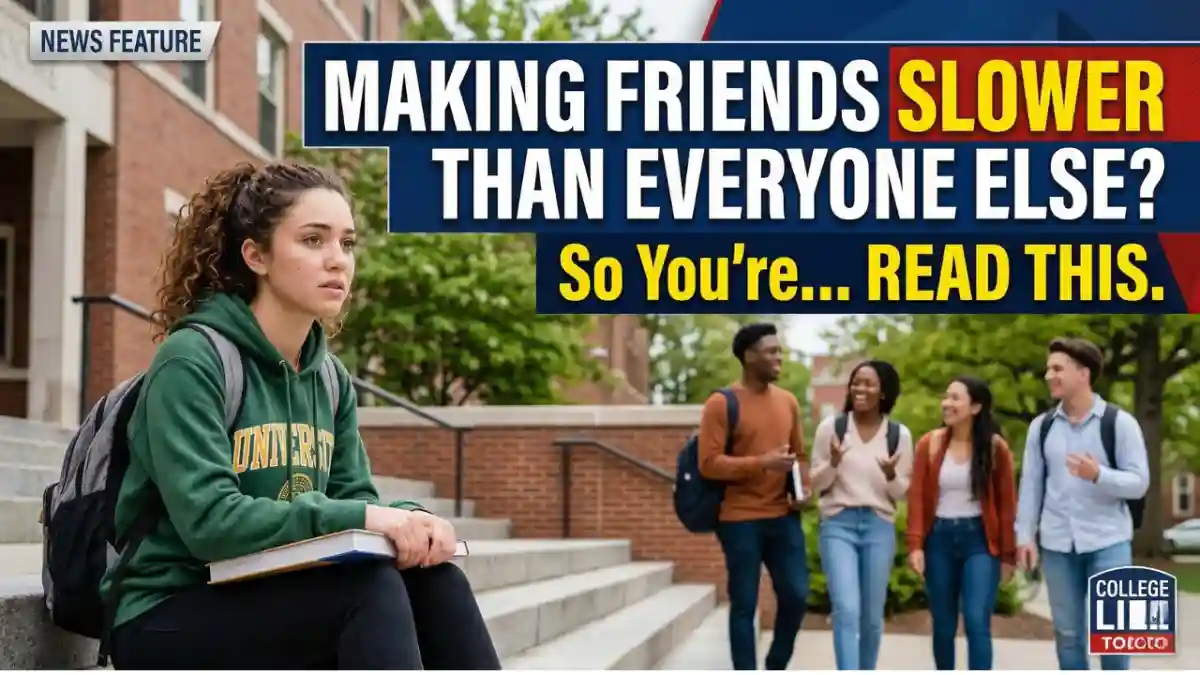
Navigating the social scene of college can often feel like the hardest part of the entire experience. You’re surrounded by thousands of people, yet it’s surprisingly easy to feel completely alone. If your stomach has dropped at the thought of walking into a crowded dining hall by yourself, or you’ve scrolled through social media wondering how everyone else seems to have found their people already, please know you are not alone. In fact, you’re part of the vast majority. A 2024 survey of over 1,000 U.S. college students found that nearly two-thirds of them feel lonely .
Making friends in this new chapter isn’t about becoming a different, super-social version of yourself. It’s about small, consistent steps, a little bit of courage, and a whole lot of grace for yourself along the way. Here’s a human guide to building your community in college.
It Starts with a Mindset Shift
Before you even walk into a club fair or a lecture hall, the most important work happens internally. The pressure to find a “best friend forever” in the first week is immense, but it’s also unrealistic. Those deep, meaningful connections you had in high school? They took years to build, not days . Allow your college friendships the same courtesy of time.
Everyone around you is just as nervous as you are. That person sitting alone in the cafeteria, the one scrolling through their phone to look busy? They’re probably hoping someone will sit next to them. Remember that “everyone is in the same boat, so everyone is much more open to starting up a simple conversation” . The person next to you in class is also trying to figure out where they belong.
And above all, be yourself. It’s a cliché because it’s true. You might be tempted to mold yourself to fit into a specific group, but the most fulfilling friendships are the ones where you feel seen, valued, and supported for exactly who you are . Don’t change your personality to become worthy of friendship; the right people will appreciate the real you .
Where to Find Your People
You can’t make friends in your dorm room. It’s the simplest and hardest truth. You have to physically put yourself in spaces where connections can happen.
Show Up and Say “Yes”
In the first few weeks, your mantra should be “yes.” Go to the weird welcome week events, the floor meetings, and the ice cream socials. “By saying yes to all opportunities and pushing yourself out of your comfort zone, you’re opening yourself up to memories [and] potential friends” . One NYU student credits her entire social life to adopting the mantra “Say Yes More,” which led her to join clubs, help with move-in crew, and attend resident assistant events . You never know which “yes” will lead you to your people.
The Power of Shared Interests
Clubs and organizations exist for this exact reason. Whether it’s the Pole Dancing Society, the Ice Skating Club, or a Latine Affinity Space, joining a group transforms you from an individual into a member of a community with a built-in shared interest .
Don’t just sign up and disappear, though. Commit to attending the meetings regularly. It’s in the weekly repetition that familiarity breeds friendship . And if your campus doesn’t have a club for your niche interest, most schools allow you to start your own—a guaranteed way to find like-minded people .
The Classroom Connection
In a lecture hall of 300 people, it’s easy to feel invisible. But smaller classes, labs, and discussion sections are golden opportunities. Talk to the person sitting next to you. Ask them about the assignment or comment on the professor’s lecture notes. This simple act can lead to forming a study group, which is a low-pressure way to turn an acquaintance into a friend . “Ask them to hang out after classes or on the weekends,” suggests one guide, noting that these are the easiest people to connect with since you already share a context .
Volunteer and Campus Jobs
Working a campus job or volunteering is a secret weapon for friendship. It gives you structure, a reason to be somewhere, and coworkers you see on a regular basis. One commuter student found that campus jobs weren’t just for paychecks; they helped him build relationships with professors and peers, turning the campus into a more familiar and friendly place .
How to Start That Conversation
Okay, you’re at an event. You see potential friends. Now what? This is where the human element gets real.
Start small. Piper Destiny, a student at UMass Amherst, shares a beautiful example: she met one of her closest friends at a bus stop. It started with a simple compliment on the other person’s outfit. That one sentence led to a long conversation where they discovered they had numerous interests in common . A simple “hi,” a compliment, or even a joke to ease the tension is often all it takes .
If you’re in class, talk about the class. If you’re at the dining hall, ask if you can join someone’s table. “Just ask, ‘Hey, do you mind if I join you?’ It’s really not as awkward as you think” . The next step is to move the connection beyond the initial setting. Ask for their socials, or better yet, invite them to do something concrete. “What are you doing after this? I’m heading to the game / getting coffee / going to the library if you want to come.”
The Unique Challenge for Commuters
If you live off-campus, the game is different, but the goal is the same. You have to be more intentional. One commuter student shares that they felt like an outsider until they started actively participating. They attended office hours to build relationships with professors, which led to department events. They formed a study group that met at a café near campus. They found organizations that fit their schedule, like a leadership program during lunch hours . The key is to find your anchors on campus and build your schedule around them.
Dealing with Rejection and Setbacks
This is perhaps the most important part: not every interaction will spark a friendship. And that is 100% okay. “Not everything worked perfectly and that’s important to acknowledge. There were moments when conversations didn’t flow, or when I didn’t feel an instant connection and that’s completely normal” . Don’t take it personally. You might be looking for a deep conversationalist, and they might be looking for a workout buddy. It’s not a rejection of you as a person.
The path to friendship isn’t linear. There will be an up and down flow in the number of people you meet. Don’t be discouraged if it dips after welcome week . If you’re not feeling connected by your second or third year, try taking on a leadership role in a club you’re in. Suddenly being the person in charge gives you a new level of connection and responsibility that can deepen your bonds with others .
Ultimately, building friendships in college is about showing up as your imperfect, authentic self and trusting the process. It’s about shared meals in the cafeteria, late-night study sessions, and spontaneous conversations at the bus stop. Be patient with yourself. Give it time. The right people will find their way into your journey, and when they do, campus will start to feel like home .