

The Masters Tournament at Augusta National is one of golf’s most prestigious events, and its leaderboard is a key part of the drama. Whether you’re watching from home, following on the official Masters app, or standing on the course, knowing how to read the Masters leaderboard turns confusion into excitement. This guide breaks it down step by step so you can track every birdie, bogey, and leaderboard shift like a pro.
Why the Masters Leaderboard Looks Different
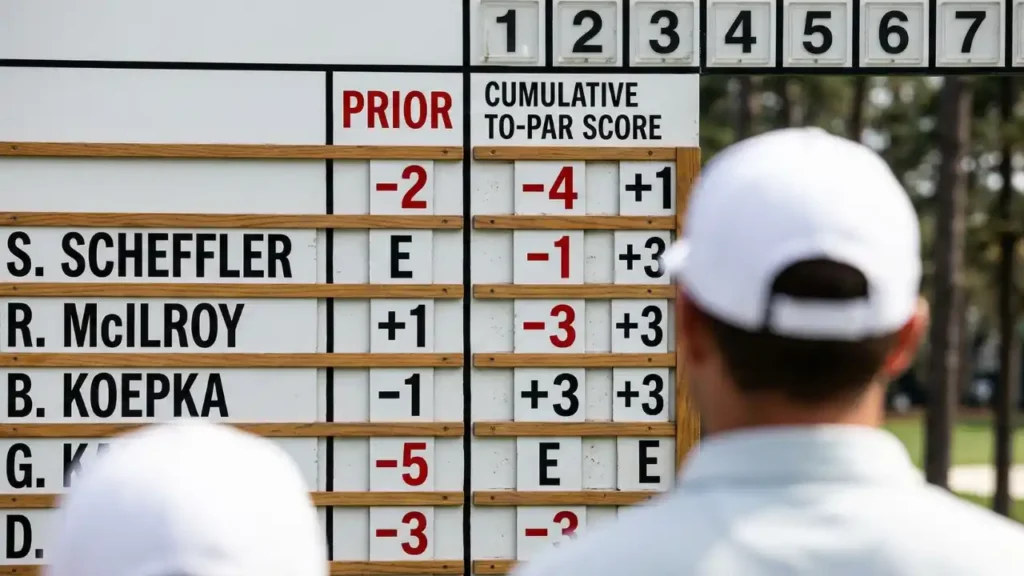
Unlike standard PGA Tour leaderboards that simply show a player’s total score relative to par, the Masters uses a unique “over/under” system. It’s designed to show exactly how each player is progressing during their current round. This format dates back decades and is proudly manual on the famous green-and-white scoreboards scattered around Augusta National.
You’ll see two main views:
- The classic hole-by-hole “Prior” view (physical boards and some digital versions)
- The more traditional summary view (most apps and websites)
Both show the same information—just in slightly different layouts.
Breaking Down the Columns on the Masters Leaderboard
Here’s exactly what each section means:
POS (Position)
This is the player’s current standing. Ties are listed together (T2, T2, etc.).
PLAYER
The golfer’s name, often with a small flag for their country. Look for a small “(a)” next to some names—that means the player is an amateur.
TOTAL (or “To Par”)
The player’s score for the entire tournament relative to par.
- Negative numbers in red = under par (good!)
- Positive numbers in black = over par
Example: “-7” means the player is seven strokes under par for all four rounds combined.
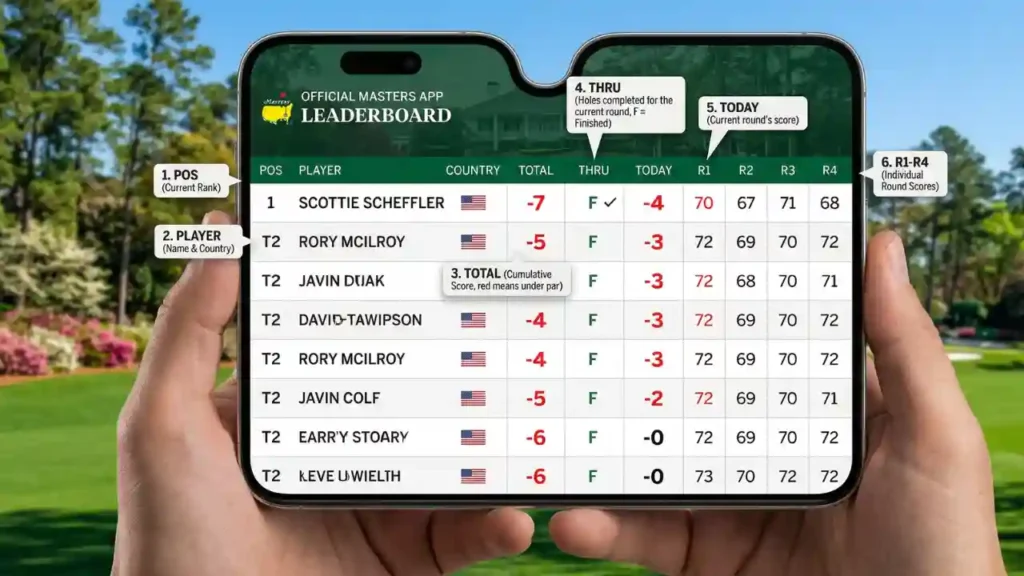
THRU
How many holes the player has completed in the current round.
- “F” or “18” = finished the round
- “5” = on the 5th hole (or just finished it)
TODAY
The player’s score for the current round only (relative to par). Again, red numbers are under par for the day.
R1, R2, R3, R4
The player’s actual score for each round (not relative to par). These add up to the final total.
FAV or star icon
Often just a favorite marker or shows if the player is a past champion.
The Famous “Prior” Column and Hole-by-Hole Magic
This is what makes the Masters leaderboard special. To the left of the player’s name you’ll see a “Prior” number (in red or green). It shows where that player stood relative to par before the current round started.
Then, as the player completes each hole (1 through 18 across the top), a new number appears under that hole. This number is the player’s cumulative tournament score to par after finishing that hole.
- Red numbers = under par overall
- The number updates live after every hole
Example:
- Player starts the round at -2 (Prior column shows red “2”)
- Birdies hole 1 → number under “1” becomes red “3”
- Pars hole 2 → number stays red “3”
It’s a running story of the round in real time.
Pro Tips for Reading the Masters Leaderboard Like a Pro
- Watch the colors — Red always means under par. The more red you see, the better the player is doing.
- Check “Today” first — It tells you who’s making the biggest move right now.
- Look at “Thru” — A player who is -3 through 9 holes is on fire; the same -3 through 17 holes means they’re holding steady.
- Follow the “Prior” updates — This is the fastest way to see momentum on the physical boards around the course.
- Use the official Masters app — It combines both views plus live video, hole-by-hole scoring, and player trackers.
Common Questions About the Masters Leaderboard
What do big numbers on the right mean?
If a player has finished their round, you’ll see their total round score (like 68) instead of a hole number.
Why are there two leaderboards?
Augusta National keeps the traditional over/under format on course boards while offering the standard summary view online for easier following.
When does the leaderboard update?
The physical boards are updated manually after every hole. Digital versions (app and masters.com) are near-instant.
Final Thought: Why It Matters
Learning how to read the Masters leaderboard lets you feel the tension of Amen Corner, the charge on the back nine, and the drama of the final round. Whether you’re a casual fan or a golf die-hard, this skill turns watching into understanding—and makes the green jacket ceremony even more thrilling.
Next time the Masters is on, pull up the leaderboard and use this guide. You’ll never feel lost again. Masters week is pure golf theater, and now you have the program.
Bookmark this page and share it with friends who are new to The Masters. The more people who understand the leaderboard, the more fun the tournament becomes for everyone.