
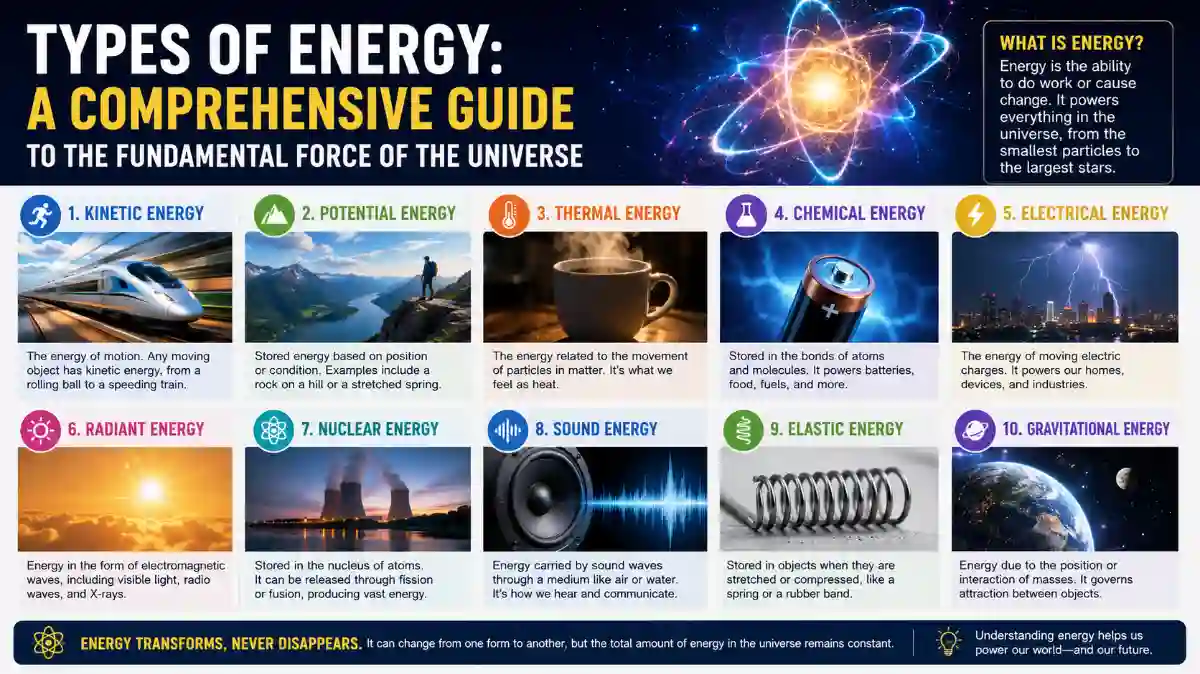
Energy is the invisible force that powers everything in our existence. From the beating of your heart to the explosion of stars in distant galaxies, energy drives all motion, change, and life itself. Defined in physics as the capacity to do work or cause change, energy exists in multiple interconnected forms. Understanding the different types of energy is essential not only for students and scientists but for anyone seeking to grasp how the modern world functions, how renewable technologies are transforming societies, and how we can build a sustainable future.
The law of conservation of energy states that energy cannot be created or destroyed—only transformed from one form to another. This principle, formalized in the 19th century through the work of scientists like James Joule and Hermann von Helmholtz, underpins thermodynamics and explains countless natural and technological phenomena. In this extensive article, we will explore the primary types of energy, their characteristics, real-world examples, mathematical foundations, transformations, and their critical role in addressing global challenges like climate change and energy security.
Fundamental Concepts: Kinetic and Potential Energy
At the most basic level, energy is categorized into two broad classes: kinetic energy and potential energy.
Kinetic Energy is the energy of motion. Any object in motion possesses kinetic energy. The formula is:
[ KE = \frac{1}{2} m v^2 ]
where ( m ) is mass and ( v ) is velocity. This quadratic relationship means that doubling the speed quadruples the kinetic energy—explaining why high-speed impacts are so destructive.
Examples abound: a moving car, flowing river, wind, or even molecules vibrating in a gas. In biology, kinetic energy manifests in muscle movement; in technology, it powers turbines in hydroelectric dams.
Potential Energy is stored energy due to an object’s position or configuration. It has several subtypes:
- Gravitational Potential Energy: Energy stored due to height in a gravitational field. Formula: ( PE_g = m g h ), where ( g ) is gravity (approx. 9.8 m/s²) and ( h ) is height. A book on a shelf, water behind a dam, or a rollercoaster at the top of a hill all hold this energy. When released, it converts to kinetic energy.
- Elastic Potential Energy: Stored in deformed objects like springs or rubber bands. Formula: ( PE_e = \frac{1}{2} k x^2 ), where ( k ) is the spring constant and ( x ) is displacement. This powers clocks, bows, and trampolines.
- Chemical Potential Energy: Stored in the bonds of atoms and molecules. This is what we release when burning fuel or digesting food.
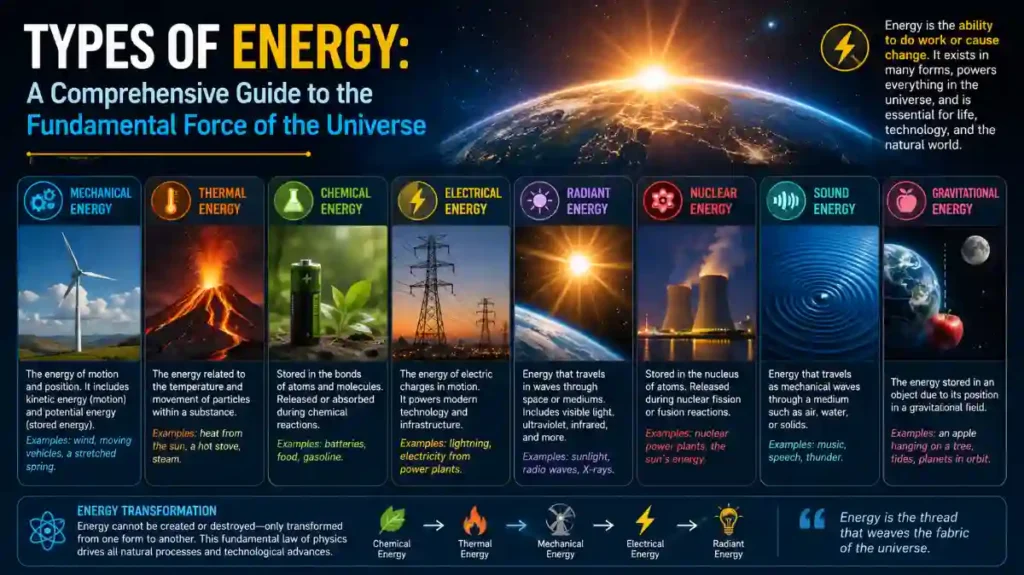
These two forms form the foundation of mechanical energy, which is the sum of kinetic and potential energy in a system. In ideal conditions (no friction), mechanical energy is conserved, as seen in swinging pendulums or orbiting planets.
Thermal Energy (Heat)
Thermal energy, or heat, is the internal kinetic energy of particles—atoms and molecules vibrating, rotating, and translating within a substance. It is directly related to temperature, though not identical (temperature measures average kinetic energy per particle, while thermal energy depends on total mass and specific heat capacity).
The transfer of thermal energy occurs via conduction (direct contact), convection (fluid movement), and radiation (electromagnetic waves). Water boiling in a kettle, geothermal vents, or the warmth from the Sun are classic examples.
In engineering, thermal energy powers steam turbines in coal, nuclear, and concentrated solar power plants. However, the second law of thermodynamics introduces entropy: thermal energy tends to disperse, making it challenging to convert fully back into useful work. This explains why engines have efficiency limits (Carnot efficiency).
Chemical Energy
Chemical energy is a form of potential energy stored in the chemical bonds between atoms. When bonds break and reform (as in combustion or metabolism), energy is released or absorbed.
Fossil fuels like coal, oil, and natural gas represent ancient chemical energy captured from sunlight via photosynthesis millions of years ago. Batteries store chemical energy through electrochemical reactions. Food provides chemical energy (measured in calories) that our bodies convert into kinetic and thermal energy.
Explosives and rocket propellants release massive amounts of chemical energy rapidly. The energy density of chemical fuels varies widely—hydrogen has high energy per mass, while gasoline offers practicality for transportation. As the world transitions away from fossil fuels, understanding chemical energy is vital for developing better batteries, hydrogen storage, and biofuels.
Electrical Energy
Electrical energy results from the movement of electric charges, typically electrons in a conductor. It is one of the most versatile and convenient forms because it can be transmitted over long distances with relatively low losses and easily converted into other forms (light, heat, motion).
The power formula ( P = V I ) (voltage times current) and energy as ( E = P t ) help quantify it. Generators convert mechanical energy (from spinning turbines) into electrical energy via electromagnetic induction (Faraday’s law). Solar photovoltaic cells convert radiant energy directly into electricity.
Modern society runs on electricity: lighting, computing, transportation (electric vehicles), and industry. Challenges include storage (batteries) and grid stability, especially with intermittent renewables.
Nuclear Energy
Nuclear energy comes from the nucleus of atoms. It includes two main processes:
- Nuclear Fission: Splitting heavy nuclei like Uranium-235, releasing enormous energy according to Einstein’s ( E = mc^2 ), where a tiny mass loss converts into energy. This powers nuclear reactors, producing heat that generates steam and electricity. One kilogram of uranium can produce energy equivalent to thousands of tons of coal.
- Nuclear Fusion: Combining light nuclei (like hydrogen into helium), the process powering the Sun. Fusion promises cleaner, near-limitless energy with less radioactive waste, but sustaining controlled fusion (as in ITER project efforts) remains a major technological hurdle.
Nuclear energy is carbon-free at the point of generation but raises concerns about safety, waste, and proliferation. It currently provides about 10% of global electricity.
Radiant Energy (Electromagnetic Energy)
Radiant energy travels in electromagnetic waves, spanning radio waves, microwaves, infrared, visible light, ultraviolet, X-rays, and gamma rays. The Sun emits radiant energy that drives photosynthesis, weather, and life on Earth.
Visible light enables vision; infrared provides heat; ultraviolet causes sunburn but also vitamin D production. Solar panels harness specific wavelengths. Lasers and communication technologies (fiber optics, Wi-Fi) rely on radiant energy.
The energy of a photon is ( E = h f ), where ( h ) is Planck’s constant and ( f ) is frequency—higher frequency (shorter wavelength) means higher energy, explaining why gamma rays are dangerous.
Sound Energy
Sound is mechanical energy transmitted as longitudinal pressure waves through a medium (air, water, solids). It originates from vibrating objects and carries kinetic and potential energy.
While sound energy levels are usually low compared to other forms (measured in decibels), it is crucial in communication, music, sonar, and medical ultrasound. In extreme cases, like shock waves from explosions, sound energy can cause physical damage.
Other Forms and Magnetic Energy
Magnetic energy is associated with magnetic fields and often linked to electrical energy in electromagnetism. Moving charges create magnetic fields, and changing magnetic fields induce electric currents.
Mechanical energy, as noted, combines kinetic and potential. In broader classifications, we also discuss mass-energy equivalence from relativity.
Energy Transformations: The Heart of Technology and Nature
Energy rarely stays in one form. A coal power plant transforms chemical → thermal → mechanical → electrical energy. In a car engine: chemical (fuel) → thermal → mechanical (motion). In the human body: chemical (food) → thermal, kinetic, and electrical (nerve impulses).
Photosynthesis converts radiant energy into chemical energy. Hydropower: gravitational potential → kinetic → mechanical → electrical.
Efficiency is key—most transformations lose some energy as waste heat due to entropy. Improving efficiency through better materials, insulation, and processes is a major focus of engineering.
Renewable vs. Non-Renewable Energy Sources
While “types of energy” refers to forms, they are often discussed alongside sources:
Non-renewable: Fossil fuels (chemical), nuclear (finite fissile materials). These dominate but contribute to greenhouse gases and resource depletion.
Renewable: Solar (radiant), wind (kinetic), hydro (gravitational), geothermal (thermal), biomass (chemical), tidal, and emerging ocean energy. Renewables harness natural flows that replenish quickly.
Global renewable capacity has grown dramatically, with solar and wind leading due to falling costs. By mid-2020s, renewables account for a significant and rising share of new electricity installations worldwide. Challenges include intermittency, land use, and material requirements for batteries and turbines.
The Role of Energy in Society and the Future
Energy underpins economic development, healthcare, education, and security. Access to reliable energy correlates strongly with human development indices. Yet, energy poverty affects billions, while overconsumption drives climate change.
Innovations like advanced nuclear (small modular reactors), next-generation solar perovskites, solid-state batteries, green hydrogen (produced via electrolysis using renewables), and smart grids are shaping the future. Energy efficiency measures—LED lighting, electric vehicles, better building insulation—offer immediate high-impact reductions in demand.
Quantum computing and advanced materials may unlock new efficiencies. Space-based solar power or fusion could provide abundant clean energy. Understanding energy types helps citizens make informed choices, from supporting policy to adopting personal habits like conservation and electrification.
Conclusion
Energy, in its myriad forms—kinetic, potential, thermal, chemical, electrical, nuclear, radiant, sound, and more—animates our universe. From the microscopic dance of particles to macroscopic power grids, these forms interact seamlessly according to immutable physical laws. As humanity faces the dual challenges of growing energy demand and environmental limits, deep knowledge of energy types empowers innovation, responsible consumption, and sustainable progress.
The transition to a low-carbon economy is not merely technical but philosophical: recognizing energy as a precious, conserved resource to be used wisely. Whether through policy, technology, or individual action, mastering the types of energy is key to securing a prosperous future for generations to come.
By appreciating the science behind a glowing lightbulb, a speeding bullet train, or the Sun rising each morning, we connect more deeply with the fundamental workings of reality. Energy is not just a scientific concept—it is the currency of existence itself.